zum Inhalt springen

Aktuelles

Stellenausschreibung Wissenschaftliche:r Mitarbeiter:in

Am Institut für ausländisches und internationales Strafrecht ist ab 01.01.2026 eine Stelle als Wissenschaftliche:r Mitarbeiter:in zu besetzen. 

Näheres entnehmen Sie bitte der Ausschreibung.

Klausuren Strafrecht III

Die Klausuren können ab sofort zu den Öffnungszeiten des Instituts abgeholt werden.

Schwerpunkt Klausuren

Die Klausuren Europäisches Strafrecht, Cyberstrafrecht und FA MP Cyberkriminalität, Internetstrafrecht und Computerstrafrecht können ab sofort zu den Öffnungszeiten des Instituts eingesehen werden.

Transnational Criminal Law Review

New grant: Innovative Tandem Collaborations 2025/26

Comparative Perspectives on Sexual Offences Law: From Consent to Sexual Harassment

Cologne International Forum Innovative Tandem Collaboration: 

1 September 2025 - 31 August 2026

Matilde Botto (University of Bologna, Italy)

Partner at the University of Cologne: Prof. Dr. Bettina Weißer (Institute for Comparative Criminal Law) 

For detailed information, please click here.
 

Gastvortrag Bettinger-López, 17.06.2025

On June 17, 2025, the Institute for Comparative Criminal Law, in cooperation with the Feminist Law Clinic had the pleasure of welcoming Professor Caroline Bettinger-López for her lecture titled "Domestic Violence as a Human Rights Violation – A View from the United States and Beyond."

Professor Bettinger-López began by recounting a case that has been a recurring focus of her work for over two decades: the case of Jessica Lenahan. The failure of the police to enforce a restraining order against Lenahan’s ex-husband ultimately led to the deaths of their three daughters. Although the order, and Colorado state law, included the language “shall arrest” in case of a violation, and a law was in effect requiring officers to make an arrest whenever a domestic violence restraining order was violated, the U.S. Supreme Court held that police officers retained discretion in enforcement under the U.S. Constitution.

Refusing to accept the Supreme Court’s ruling, Lenahan approached the American Civil Liberties Union, stating: “Everybody has a boss. The Supreme Court needs a boss.” With the support of the ACLU and Professor Bettinger-López, the case was taken to the Inter-American Commission on Human Rights. In a landmark decision, the Commission found that U.S. police and courts had violated Articles I, II, VII, and XVIII of the American Declaration of the Rights and Duties of Man. From these violations, it derived a state duty to protect women and children from domestic violence. Drawing on this ruling, Professor Bettinger-López illustrated how gender-based violence constitutes a violation of fundamental human rights, such as the right to a dignified life, to equality, and security of the person. The conclusion of this first part of the lecture already gave rise to a lively discussion.

In the second part, Professor Bettinger-López discussed her efforts to integrate human rights principles into U.S. law. In the face of the fact that the Commission’s decision in the Lenahan case placed no binding obligations on U.S. lawmakers, her policy work came to focus on both collaboration with municipalities and advocacy at the federal level. For instance, she contributed to the development of a gender-sensitive guidance for police officers responding to domestic violence cases.

Professor Bettinger-López also offered a critique of U.S. exceptionalism by taking a global approach: while the United States has developed policies and programs aimed at eliminating gender inequality abroad, it has long lacked a comparable domestic framework. In 2023, Professor Bettinger-López served as a Senior Advisor in the Biden-Harris Administration and co-led the development of such a framework: the U.S. National Plan to End Gender-Based Violence. Drawing inspiration from models adopted by other countries, the Plan particularly stresses prevention and includes mechanisms for monitoring its implementation.

Following a lively round of applause, the lecture concluded with audience members raising nuanced questions about gender-based violence in the U.S.

Salka Suhr

Gastvortrag Caroline Bettinger-López, 16.06.2025

Law Clinics, Universities and Liberal Thought: Finding Clarity in a Time of Chaos and Cacophony

It takes a particular type of mental energy to blend out the discrepancy between the practical circumstances in which the ICCL’s most recent guest lecture by University of Miami School of Law Prof. Dr. Bettinger-López came together on a sunny Monday evening (June 16th) at the Cologne International Forum – the University’s International House had kindly agreed to cooperate with us and the Chair for US Law, the talk was advertised through all major University communication channels, critical voices were welcomed during the discussion and this report will most likely be published uncensured on the University website – and the actual content of the talk: “Law Clinics, Universities and Liberal Thought: Finding Clarity in a Time of Chaos and Cacophony.”. 

The space that we at the University of Cologne still take for granted – to hear from speakers from other countries, to compare and exchange ideas, to agree and disagree – is shrinking for Bettinger-López and her colleagues at US-American universities and law schools. To be sure: Law clinics such as the Human Rights Law Clinic which Bettinger-López leads at her university – like all organizations that speak truth to power – have met with persistent irritation from politicians and big business before. Even the law faculties themselves have sometimes made it more difficult, for example, by withholding status and tenure for clinicians. However, the most recent Trump Administration’s attacks on universities all over the country have heightened the stakes for critical engagement to an unprecedented level: In a country where both private and public universities depend – despite support from private donors – largely on federal government funding, withdrawing several hundred million dollars from a university (as has happened to Columbia University) – leaves an impact. So do new systems of post-tenure review (so far, for public universities only): Where lifetime employment as a university professor is no longer a guarantee and nationalist sentiments become mainstream, fearmongering and polarization in the faculties is the consequence. In a climate like this, publishing a simple student report – such as this one – might still be possible – but – university administrations and communications departments are increasingly scrutinizing the work of law clinics, balancing academic freedom and law clinic confidentiality with what words and concepts could land the university on a “blacklist” with the federal or state government.   On the one hand, accepting a university’s new communications guideline might turn out to constitute just the right amount of flexibility to keep the peace (and government funding) while saving energy for more important political battles which may very well lie ahead. On the other hand, Prof. Bettinger-López described the unease with which university professors in the country of free speech direct their students to be careful what they say and write. 

Many law clinics are working to alleviate the most drastic consequences of the first few months under Trump II: Immigration Law Clinics have been working to support migrants facing deportation with rapid response teams (such as at Cornell); another clinic at Northwestern supports protesters with legal advice. Still, the two US-Americans in the room, Prof. Bettinger-López and Prof. Junker from the University of Cologne’s Chair for US Law agreed that Trump II and its project 2025 took American universities and law clinics by surprise. The networks and strategies to protest and persevere are building, but slowly. Law Clinics and Universities as protective spaces for liberal thought? – for Prof. Bettinger-López and her colleagues, this idea has suddenly turned from a liberal democracy standard to an institution that depends on every individual’s willingness to fight for it. 

Laura Midey 

Gastvortrag Dr. Christoph Hebbecker

Am 16. Mai 2025 hielt Dr. Christoph Hebbecker von der Generalstaatsanwaltschaft Köln einen Vortrag im Rahmen der Gesprächsreihe „Internationales Strafrecht“, zum Thema „Digitale Hasskriminalität – Ermittlungsansätze und aktuelle Entwicklungen aus Sicht der Strafverfolgungsbehörden“. Sein Vortrag erfolgte zugleich in Kooperation mit der Feminist Law Clinic im Rahmen der Ringvorlesung „Feminismus & Recht“. 

Zu Beginn stellte Dr. Hebbecker die „Zentral- und Ansprechstelle Cybercrime Nordrhein-Westfalen (ZAC NRW)“ vor und skizzierte dann relevante Straftatbestände wie z.B. §§ 86, 86a StGB (Verbreiten bzw. Verwenden verfassungswidriger Kennzeichen), § 130 StGB (Volksverhetzung), § 140 StGB (Billigung von Straftaten) und §§ 185 ff. StGB (Beleidigungsdelikte), mit deren Verfolgung Abteilung 3 der ZAC zu digitaler Hasskriminalität befasst ist. Er berichtete über die Initiativen „Wer hetzt, verliert!“ und „Verfolgen statt nur Löschen“, die sich in Kooperation mit Bundesliga-Fußballvereinen und Mediengruppen zur effektiveren Verfolgung von Hasskriminalität einsetzen. Als zentrales Problem bei der Verfolgung von Äußerungsdelikten identifizierte Dr. Hebbecker den Anzeigeprozess und sprach über digitale Lösungsmöglichkeiten sowie über Hürden bei deren Umsetzung in der Praxis.

Anhand eindrücklicher Praxisbeispiele widersprach Dr. Hebbecker dem Narrativ, die Verfolgung dieser Straftaten bilde einen Angriff auf die Meinungsfreiheit und betonte, Strafverfolgung in diesem Bereich ziele gerade darauf ab, Räume zu schützen, die gerade die Ausübung der Meinungsfreiheit gewährleisten sollen. Herr Dr. Hebbecker veranschaulichte zudem Herausforderungen bei der Identifizierung von Beschuldigten im digitalen Raum anhand von Auskunftsersuchen gegenüber internationalen Big-Tech-Konzernen. Zuletzt setzte sich Herr Dr. Hebbecker mit aktuellen Gesetzesreformen auf europäischer (Digital Services Act) und nationaler (Digitale-Dienste-Gesetz) Ebene auseinander. Er bewertete die Bestrebungen dabei grundsätzlich positiv, wies jedoch kritisch darauf hin, dass Anzeigepflichten der Online-Plattformen im Vergleich zum Netzwerkdurchsetzungsgesetz abgeschwächt wurden.

Paul Matthies

Gastvortrag: Dr. Kalika Mehta

Permanent Suspicion: Tracing Coloniality in Criminal Law

“Permanent suspicion” is what our most recent guest and speaker as part of our ICCL lecture series, Dr. Kalika Mehta, both detected (regarding colonial subjects) and advocated for (regarding criminal laws today) in her research, tracing – as the subtitle of her talk suggested – coloniality in criminal laws. A quick Google search („It didn’t take me long to google these examples.“) hints at the extent of the problem: “Crimmigration“, the populist entanglement of migration and crime in the German public discourse, structural racism in the United Kingdom police force and a recent Indian bill for tougher rape laws all form part of a phenomenon central to the post-colonial analysis of criminal law: Construction of the other. This concept, Mehta explained, connects the historical episode of European colonialism (yes, dispossession of land is a recurrent feature of history, she concedes to popular criticism, but: 85% of the globe were colonized by European powers, this European colonialism was much more violent and constituted a parallel development to the expansion of modern capitalism, thus its extractive nature which resulted in a complete restructuring of colonial economies where human and natural resources only ever flow in one direction, the mother country) to today’s political and legal realities. It helps us trace coloniality, which Mehta defines as the continuation of colonialism as a belief system and pattern of thought that persists despite decolonization, which is to be understood as a continuing practical process. In fact, historical colonial powers, motivated by what Frantz Fanon called permanent suspicion against the colonial subject, used the construction of the colonial subject as the other, for example, as part of their anti-vagrancy laws, as a key feature of their oppressive regimes. While those political structures have ceased to exist, Mehta concluded, it is their “boomerang” effects in the Metropole, hidden in concepts such as the neutrality of law, the universality of international law or common modes of interpretation of law, which we as criminal law scholars should be suspicious towards today. What remains of law as a concept in the face of such fundamental criticism? While Mehta advocates constructive reform, she remained skeptical when asked, in the subsequent discussion, about the counter-hegemonical potential of international criminal law (one of her many other areas of expertise): Without Global South inclusion in, for example, the development of the list of core crimes, permanent suspicion towards the concept of an international community, remains, in her opinion, necessary. 


Laura Midey 

Gastvortrag: Dr. Matilde Botto

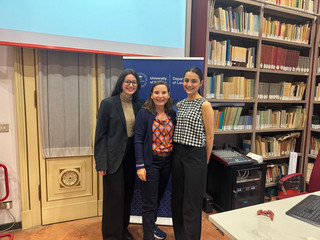
On April 15, 2025, Dr. Matilde Botto from the Università di Bologna gave a guest lecture as part of the International Criminal Law series, held in cooperation with the Feminist Law Clinic. Her talk, "Comparative Perspectives on Sexual Offences Law Reform: The Role of Consent and the Distinction between (Sexual) Assault and Harassment", provided valuable insights into Italian sexual offences law, placing it in a broader European context through a comparative legal lens. 

Dr. Botto began by outlining the concept of sexual autonomy, focusing on the protection against unwanted sexual contact (negative sexual autonomy). She identified two key challenges for European lawmakers: transitioning to a consent-based legal model and addressing non-physical sexual harassment in criminal law. While international and EU standards increasingly demand consent-based frameworks, national laws vary. Dr. Botto presented different legislative approaches and emphasized the necessity to adapt to new – especially digital – forms of harassment.

In the Italian context, she examined Article 609-bis of the Penal Code – the only provision explicitly criminalising sexual violence, limited to physical acts. This broad provision covers both minor harassment and serious assaults, without a clear legal stance on consent. Dr. Botto criticised the lack of legal precision, noting that while the courts’ broad and often liberal interpretations may align with international standards, they also raise concerns regarding the principle of legality. She called on the Italian legislature to provide clearer legal definitions and to include non-physical harassment, which is currently only addressed indirectly through general offences like “stalking.”

The lecture concluded with a lively discussion, further exploring legal avenues for criminalising sexual harassment.

Salka Suhr